
Riding the Race Week Waves
Help Your Mind Work For You, Not Against You
by Chris Bagg
“Most people walk to the start line as if they’re about to go over the trenches,” says Simon Marshall, sports psychologist, in today’s episode of The Infirmary, and he’s not far off. Race week can be a minefield of difficult emotions and thoughts, each one able to derail your performance. Can you remember the dread you might have felt ahead of your last event? Worries about the water temperature, the clash of limbs you know you’ll experience when the swim starts, the old athletic fears “What if I get dropped? What if I don’t finish? What if I come in last?” all thumping around your brain like an unbalanced dryer load.
Remember that thoughts lead to feelings, and feelings lead to behavior. Since that’s a well-established fact of performance, whether in the sports world or not, we need to respect our thoughts, understand them, and not try to control them, all while not letting them control us! Remember that there is nothing objectively good or bad—we assign “good” or “bad” based on our thinking, and if something is “bad” then it will trigger “negative” emotions (I put negative in quotes, there, because I just pointed out there is no objective good or bad, but there are feelings that can help us…less when we’re trying to do something difficult). Here’s an example thought pattern of someone who is getting “dropped” (can’t keep up) in a race:
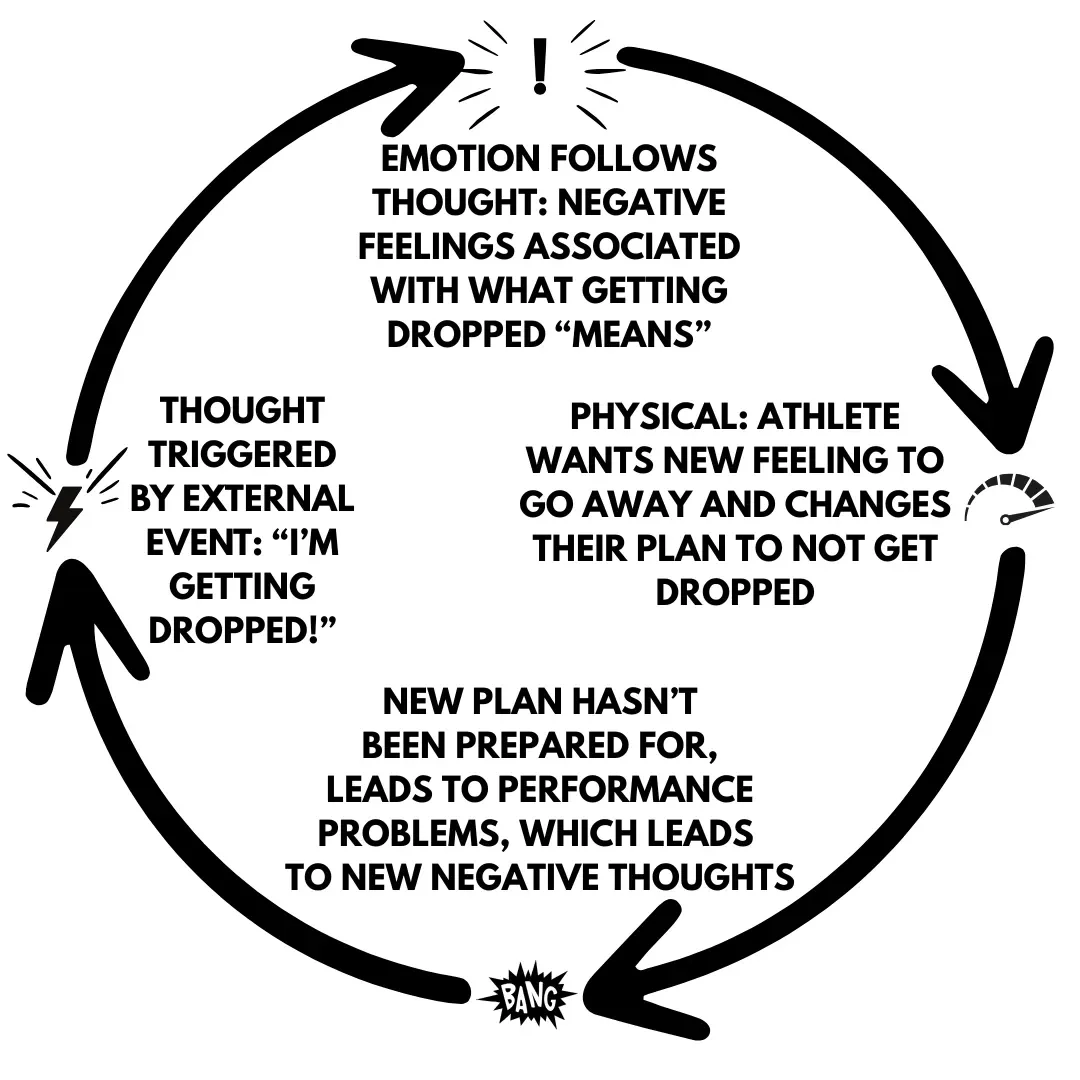
Obviously this is not a helpful thinking → feeling → behaving pattern, one that can and will get us into trouble on race day. Today we’re going to talk about three tactics that can help you ride the emotions of race week, so you can arrive at the start line psyched up…not psyched out.
Your Mind Is a Terrible Thing to Let Roam
A Pre-race Routine Doesn’t Mean Just Race Day (although do that, too)
Anxiety and Excitement = Same Thing
Your Mind Is a Terrible Thing to Let Roam
What’s the worst thing that could actually happen? Name it so we can get above it and see it for what it is worth. If we don’t get clear on the fear and see it for what it is, it will remain hidden behind us like a shadow, directing our movements. Often there is a belief about ourselves behind our fears, and if we can see those beliefs more clearly we can dispel the power they have over us. Let’s consider an athlete who is worried about getting beat up in the swim. They don’t like that kind of contact; it scares them, which makes a lot of sense! Trying to move in an environment that can kill you while getting punched in the head, the side, and the legs can be terrifying. But because this athlete doesn’t like that kind of contact, they avoid it in their training, and suddenly it’s race week and now they feel unprepared: gosh I hate the swim. It’s so uncomfortable. Why do I have to do this sport like this? I’ll just wait for everyone else to start, or I’ll swim way off to the side where nothing can go wrong, their thinking might go.
That’s a fair solution, but one that means the athlete is sacrificing performance. Swimming in a group is faster (and less tedious) than swimming on your own, so if this athlete wants to perform, they are at an impasse. They tell themselves that if they want to meet their goals they can’t avoid the group, so they keep thinking about how hard it will be, and then the fear begins to grow and change. Why? Because you are feeding it without stepping back to see it for what it worth:
“I’ll get beat up in the swim, then I’ll get dropped, then I won’t make the bike group I want, then I’ll have to ride too hard, then I’ll blow up on the run, then I’ll have wasted all of this money and time and people will see me walking and think that I don’t know what I’m doing and the whole experience will have been pointless.”
That fear is running rampant right now. You’re letting the scared part of your brain be free-range, and that’s never good, because you might see that, left to itself like this, the fear grows and changes. Instead of giving in and letting the fear act like a crazed, free-range chicken, bring yourself back to earth by sitting down and WRITING (yes, do it, it’s more powerful) your answers to these questions:
Your fear might be realistic, but is the end result the most likely thing that will happen?
What’s something that’s more likely to happen, given your experiences?
What’s one small thing you can do this week to minimize the chances of the outcome you are imagining happening?
Can you see that this is a story you are telling yourself?
Can you thank the fear for trying to protect you and ask it to accompany you instead of trying to get you to do something different?
“Your brain is wired to avoid the consequences of mistakes. Your brain is not wired to correct flawed thinking. The brain is about consequences. That’s why negative thoughts appear, because our brain is trying—badly—to protect us. There’s a shift in psychotherapy right now from a control model, where we try to smash the negative thought, to change it, to a more compassionate way of thinking, which is to jump hand in hand with our fear, to accept the fear as something that is part of us to be included and listened to, rather than told to stand in a corner.” — Simon Marshall
A Pre-race Routine Doesn’t Mean Just Race Day (although do that, too)
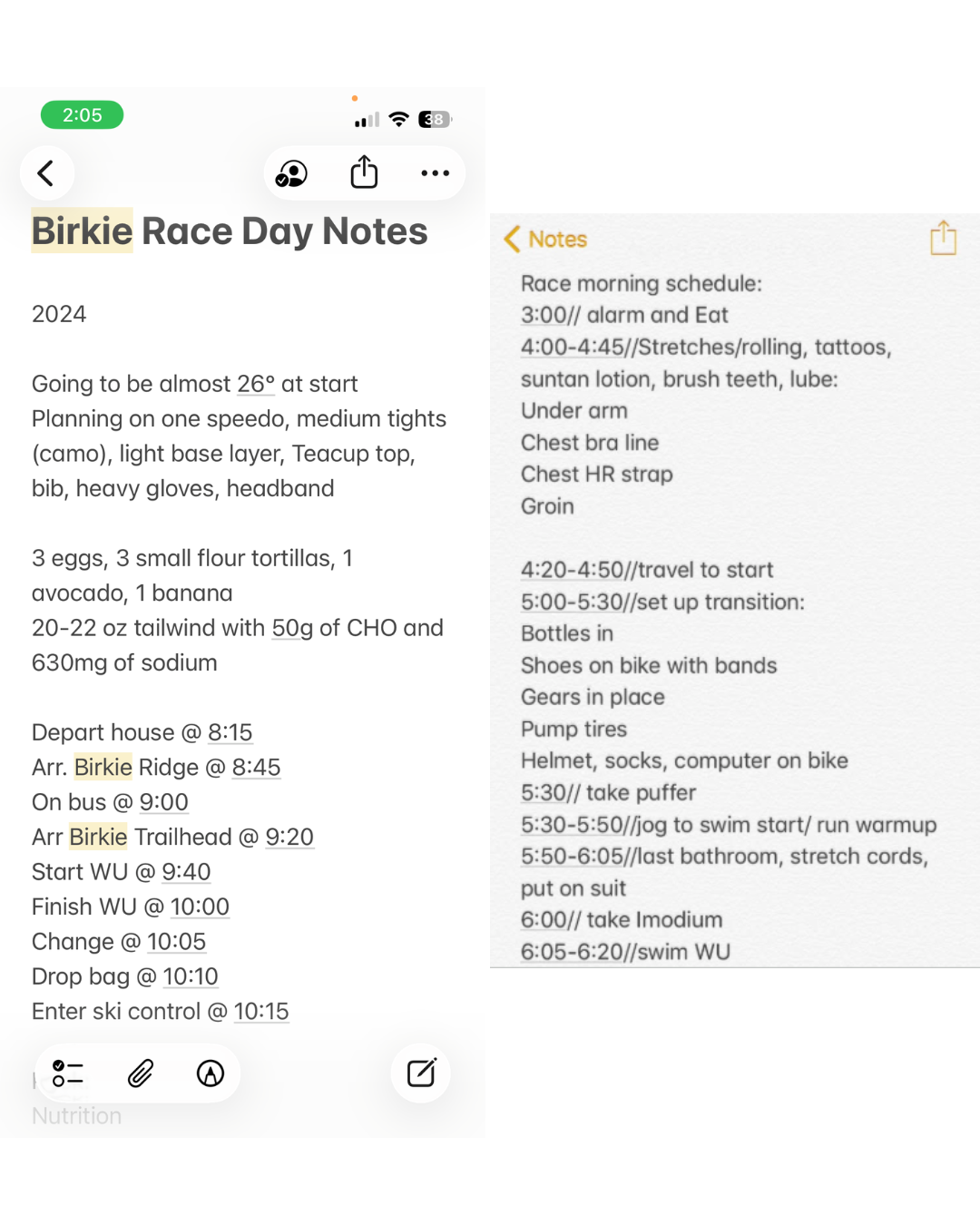
Pre-race routines smooth out anxiety because they give you a concrete plan for race day and race week, which lowers uncertainty: you know what you’re going to be doing and when you’re going to be doing it. Anxiety, on the other hand, LOVES guessing/uncertainty—it’s the soil in which it grows best. So let’s do our best to minimize uncertainty on race day and race week. Notice I said “minimize,” though; we cannot eliminate uncertainty, much in the same way that we told you you cannot eliminate fear, above. You need to minimize as much uncertainty as you can, and then recognize that whatever is left over is simply something to live with, and you can live with it. Let’s start with race day.
What do you need to do race morning? Work backwards from the race start. Two examples are below:
But pre-race doesn’t just mean race day! What is your perfect race week? What would it incorporate? How can you build in space to step back and perform the “name your fear” exercise above? Are you someone who A) likes thinking about the race or would prefer to B) dissociate? If A can you build in some “race thinking” blocks where you go over your plan and focus on what you’re going to do and do your race week visualizing? If B what are restful ways you can distract yourself that don’t allow your brain into “free-range” that can lead to issues.
Anxiety and Excitement Are Two Sides of The Same Coin
Anxiety is simple: “something is going to happen, I don’t know what” and, as we said above, anxiety loves uncertainty. When we find ourselves in this place of uncertainty, it can easily turn towards anxiety, which we tell ourselves is a bad thing.
But what if there were a different way to interpret the uncertainty? Think back to the last time you were excited about something: a first date, a new social group, a new hobby you think you might like. You don’t know what will happen there, too, but your emotions won’t be entirely negative. If they were, you wouldn’t go on the date, join the group, or try something new. “Something is going to happen, I don’t know what” is also the definition of excitement. We don’t need to automatically assume that “I don’t know what” means something negative. Sure, you’re going to be nervous about the first date (“Will they like me?”), the new social group (“Will I be accepted?”), or the hobby (“What if I’m shit at it?”), but can you see that some of those butterflies are exciting. Not knowing can feel good, too, and as we know from the thinking → feeling → behaving cycle above, a positive feeling can lead to positive behaviors. Can you see that not ALL of the “I don’t know what” are negative? Are your reasons for thinking of them as negative accurate or might you be blowing them out of proportion?
Make a list of the POSITIVE things that could happen in that “I don’t know what” (i.e. swim goes great, you deal with contact, you find a good group to swim with, you have a relaxed bike ride, you have plenty of energy for the run), so you have a script of responses you can say to yourself when your brain starts to run off with your race, telling you that the uncertainty is going to burn your race to the ground.
You can never eliminate uncertainty, nor would you want to—the uncertainty is actually something your brain and body are seeking, a challenge to rise to, the sharpening stone to your knife, the reason you are drawn to this activity, probably! So let some of that uncertainty be excitement, and instead of avoiding the activity or talking yourself out of it, try to find some curiosity about what’s going to happen, and then go and find out on race day.
Conclusion
Race week and race day can be uncomfortable. We spend much of the time before the race wishing that it was time to start, already. A part of us knows that once we get going we’re probably going to be fine, which is another piece of evidence that all of this discomfort is thinking-produced.
We don’t need to let the discomfort derail our races, though. If we can remember a simple framework during race week and on race day, we can set ourselves up for a fun, relaxed, successful performance. That framework is:
Identify the fear and then, instead of fighting it, ask it to come along with you. “Jump hand-in-hand with your fear,” Simon tells us.
Build a pre-race routine for the week and for race day that minimizes uncertainty.
See the remaining uncertainty for what it is: understandable anxiety but also positive excitement, something we can use as fuel to stay positive and upbeat as we approach our races.
Simon points out in today’s episode that “if you could see the thoughts of the others around you on race day, you’d be alarmed but you’d also be comforted: everyone is struggling to keep it together, and everyone is dealing with some level of fear.”
Once you realize that you are not alone, that your fear can be a helpful companion if you let it, that routine lessens uncertainty, and not all uncertainty is bad you will be well on your way to having not only the race you want, but the life you want, too: one that moves confidently in fearful and challenging situations.
Citations
Neenan, M., & Dryden, W. (2002). Life coaching: A cognitive-behavioural approach. Brunner-Routledge.
Ferriss, T. (2017). Tools of titans: The tactics, routines, and habits of billionaires, icons, and world-class performers. Houghton Mifflin Harcourt.