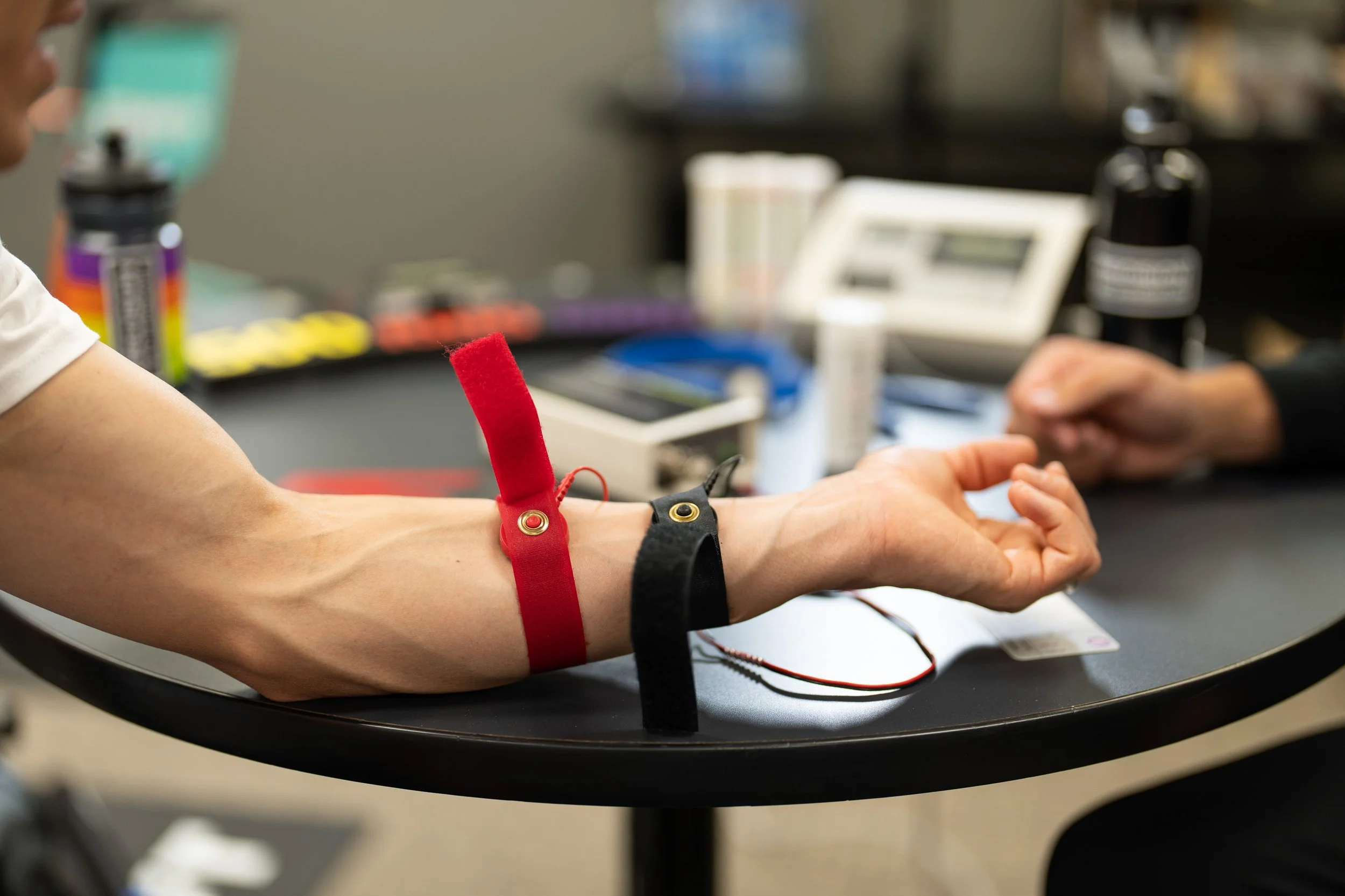
A Precision Hydration Sweat Test gives you an accurate, science-backed reading of your sodium concentration — the key electrolyte lost in sweat. It's non-invasive, takes about 45 minutes, and requires nothing more than sitting comfortably while the test runs.
Because this is largely genetically determined and stable throughout your adult life, most athletes only need to take it once. You walk away with a personalised hydration strategy — what to drink, how much, and when — built specifically around your physiology.
No blood draws. No treadmill sprints. No lab wait times. Just data that changes how you race.
**When you purchase a sweat test, Chris will get in contact with you about scheduling your test at your location**

Lactate testing equips you with the knowledge of which intensities you should train at for the best outcome in the shortest time. How?
The test gives us two lactate thresholds, the first lactate turn, sometimes called “the aerobic threshold,” (which is a bit of a misnomer), and the second lactate turn, sometimes called “the anaerobic threshold” (also a misnomer). Despite the lack of effective titling, the concepts remain: the first lactate turn gives us the power or heart rate at which you will best build endurance abilities, and the second lactate turn gives us your threshold power or heart rate, the second most important training range for endurance athletes.
The test is a 90-minute session, during which you will warmup and then perform a ramp test. Your coach will take a blood sample at each step of the ramp, continuing until you can…no longer continue due to the intensity. After the test you will get a individualized report detailing:
Your lactate profile (a graph)
Your first and second lactate turn points, in wattage or heart rate or both (both is better!)
Suggestions for your detailed training ranges to optimize your endurance training
You will need an indoor trainer, either smart or dumb. If you do not have one, you can tell us and we will bring one to your test.
The test involves taking blood samples with small lancets, test strips, and a lactate meter. The amount of blood is small, but your coach will be wearing gloves, and your fingers may be sore for a day or two.
No results match your search. Try removing a few filters.
